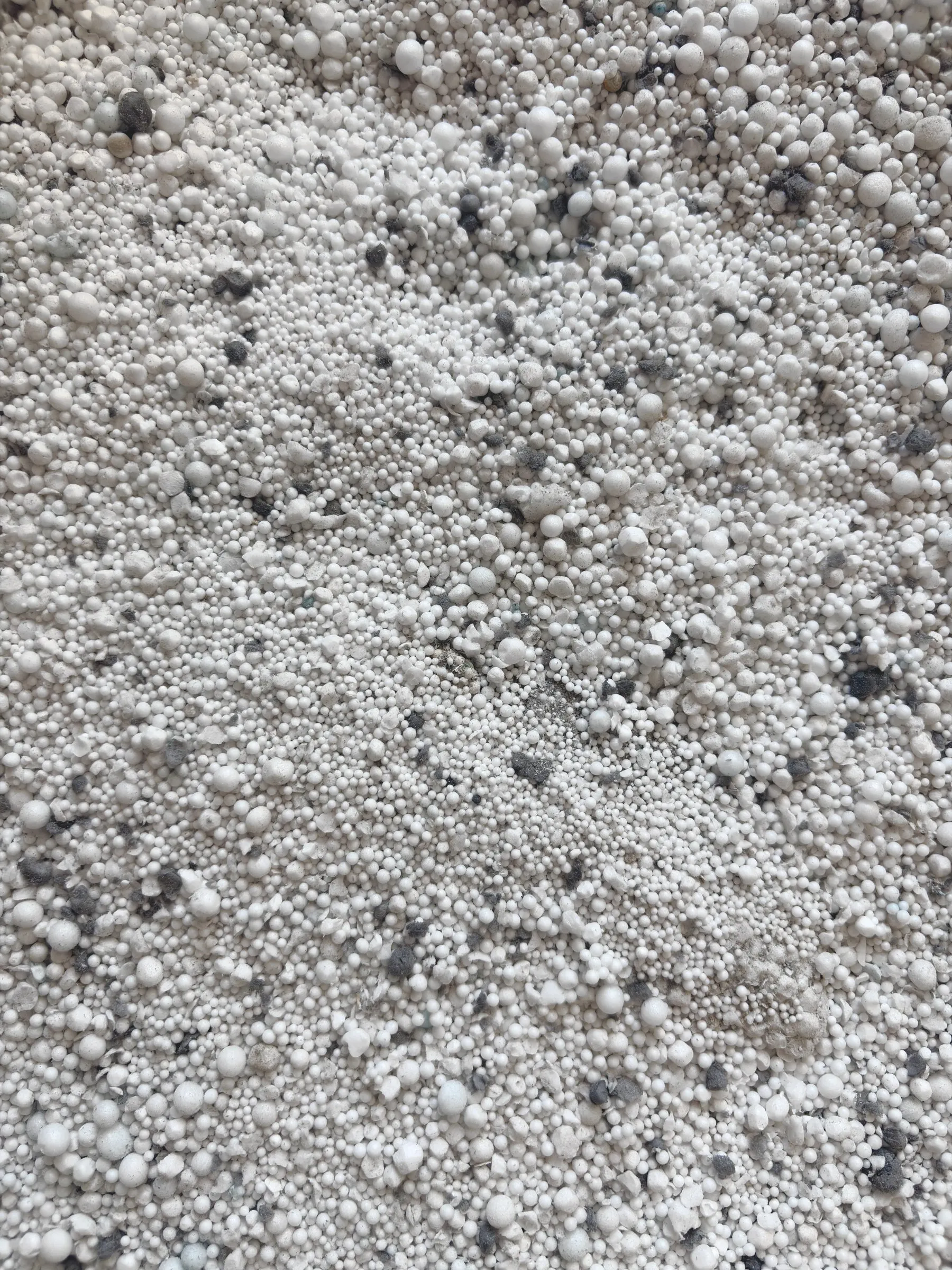
Why EPS.
Why beads.
Why R-Beads.
EPS is the most insulating among construction aggregates. The expansion process runs on steam at 80–100 °C, generating minimal CO₂ and consuming little energy. It is non-toxic, contains no volatile substances, and is extremely light to transport — which cuts the emissions of logistics too.
That ratio is the whole argument. EPS is highly efficient: only two per cent of the finished product is actually plastic — the rest is trapped air, and the air is what insulates. Of the aggregates used in construction, it is also the least impactful.

The key ingredient
of our technology.
EPS is lightweight; cement is heavy. Mix one into the other and you get bead flotation — the beads rise, the mix separates, and performance becomes a lottery.
E.I.A. was developed to solve exactly that. This exclusive, fully organic patented additive — and the reason Politerm® is blue — enables one simple, essential thing: the uniform mixing of beads within the cementitious mixture.
The mixture is cohesive, sealed and uniform. Politerm® Blu does not shrink. The beads are perfectly distributed, so every cubic metre of finished product has the same density and the same energy performance.
Turning end-of-life
into a new beginning.
EPS recovery is often mentioned and rarely explained. With Edilteco Technology a bead is not meant to become waste: it can be separated, regenerated and returned as a valuable resource. This is the actual sequence.
- R-educedCollection & recovery logistics
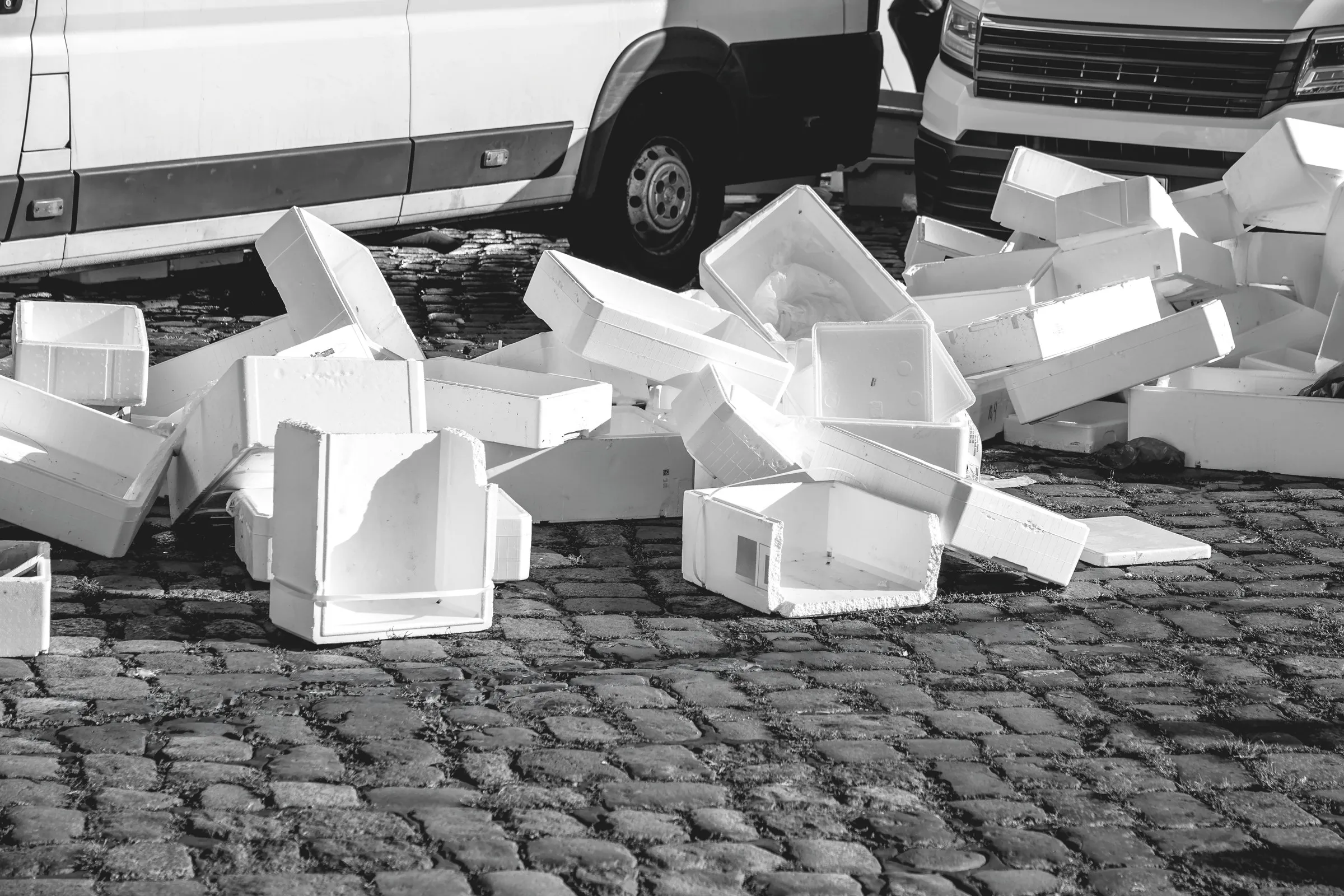
EPS residues — from packaging and industry, or from demolition and refurbishment — are intercepted and collected in a controlled manner, reducing dispersion and contamination. Proper delivery gives the industrial process a traceable, consistent input.
- R-ecycledGrinding & regranulation
A first size-reduction stage turns the collected EPS into coarse granules; regranulation then refines them to a controlled particle size. Where the EPS came from a building, dedicated separation removes the cementitious component first — recovering the mineral fractions too. Conventional grinding destroys the bead structure, and there is no way to restore it; controlled regranulation keeps it intact, together with its water resistance.
- R-eusedA new resource: Politerm® R
Re-additivation with E.I.A. restores compatibility with cementitious mixes. R-Beads + E.I.A. = Politerm® R, a ready-to-use raw material reintroduced into production, with measurable benefits in circularity and LCA.
Why R-Beads
make business sense.
- Reuse in new mortars and lightweight concretes.
- Immediate integration into formulations already licensed.
- Reduced dependence on virgin raw material — so lower supply risk and greater production continuity.
- Measurable environmental impact within LCA assessments.
- Alignment with regulations still to come.
- Differentiation that is concrete and scalable, rather than declared.
You can become an Edilteco Partner by implementing the circular economy of R-Beads alone.
Two plants close the loop.
The EPS Crusher & Regranulator handles packaging, boxes, panels and boards. The EPS Separation Plant handles the harder case: EPS contaminated with cement and aggregates, the material that demolition sites treat as impossible. Both feed the same destination — regranulated beads re-additivated with E.I.A., which is to say Politerm® R.